
The Constitutional Case AGAINST Racial Gerrymandering
A breakdown of the recent landmark SCOTUS ruling that will shape our Congressional Map for decades to come.

Americans of all political creeds, have always cherished the right to free and fair elections as a core tenet of our society. That tenet is possible, and only possible, through a few critical variables: Suffrage for all adult citizens, limiting election fraud, and minimizing disenfranchisement as much as possible. Over the years, the United States has had a series of scattered controversies relating to voter disenfranchisement, specifically, controversies surrounding the ways certain US states have drawn their Congressional Maps for seats in the House of Representatives—a practice formally known as gerrymandering. Since early 2025, there has been a series of “races” between Democrat-majority and Republican-majority states to gerrymander their representation in the House to favor the respective parties in power ahead of the 2026 Congressional midterms. Last week, the Supreme Court handed the Republican Party a victory that could change the entire direction of the gerrymandering races.
On April 29, 2026, the Supreme Court published their landmark ruling for the case Louisiana v. Callais, which ruled on the legal standing of Section 2 of the 1965 Voting Rights Act (VRA). In this ruling, the Supreme Court ruled that no majority‑minority district is legitimately mandated by the VRA. This decision is set to have major consequences for how our House of Representatives will look, in terms of party control, for the next few years, or decades even. The ruling was widely condemned by the Progressive apparatus of American politics. Groups including the American Civil Liberties Union (ACLU), the Southern Poverty Law Center (SPLC), and the National Association for the Advancement of Colored People (NAACP) all released press statements accusing the Court of “rolling back voters rights,” and “setting our nation back” by decades. Here is what I have to say about that: When one actually looks at the judicial interpretation of the Opinion of the Court, not only does it align with statutory law, but it also makes one realize this ruling was long overdue.
What Led to This Ruling
The Voting Rights Act of 1965
On August 6, 1965, President Lyndon Johnson signed into law the VRA, which was viewed as a historic landmark piece of legislation during the Civil Rights Movement. What this did was enforce the Fifteenth Amendment of the United States Constitution—the one which extended suffrage to Black and Brown Americans—the proper way by abolishing racialized voter practices such as literacy tests and polls taxes. The particular section of the VRA that was challenged at the Supreme Court is Section 2, which states:
No voting qualification or prerequisite to voting, or standard, practice, or procedure shall be imposed or applied by any State or political subdivision to deny or abridge the right of any citizen of the United States to vote on account of race or color.
This was long perceived as encouraging the drawing of Majority-Minority districts because it was prohibiting districting plans that diluted the ability of racial or language minorities to elect candidates of their choice.
The Louisiana Congressional Map
Following the 2020 Census, the state of Louisiana was assigned six seats in the United States House of Representatives. According to the Census data, of Louisiana’s population of 4.65 million residents, 1.6 million were black, making Blacks 31.4% of the population. Based on the population data, Louisiana drew a congressional redistricting map, where District 6 specifically, was alleged to be an impermissible racial gerrymander. The map was created in response to a previous lawsuit, Robinson v. Ardoin, where plaintiffs argued that the prior map violated Section 2 of the Voting Rights Act by diluting minority votes. To address these issues, the Louisiana Legislature adopted a new map (Senate Bill 8) that included a second majority-Black district that was signed into law by Governor Jeff Landry on January 22, 2024.
SBl 8 was formally challenged on February 1, 2024, when a group titled “non-African-American voters” filed a lawsuit against the bill. The plaintiffs in this case claimed that this new map violated the Equal Protection Clause of the Fourteenth Amendment by prioritizing race in its creation. On April 30, 2024, a 3-judge panel concluded in a 2–1 ruling that District 6 of the new map did indeed violate the Equal Protection Clause, leading the court to issue an injunction against using this map in future elections. Following this ruling, the decision was appealed once again to the Supreme Court. The case was officially docketed August 1, 2024 and oral arguments were heard on October 15, 2025.
The Case Against Racial Gerrymandering
Justice Samuel Alito, who rooted his judicial review in a textualist interpretation of Section 2 of the VRA, wrote the 6–3 Opinion of the Court for Louisiana v. Callais, expounding on how it remains consistent with the Constitution’s prohibition on racial classifications by government. Alito argued that Louisiana’s congressional map was unconstitutional because the state intentionally used race as the predominant factor in creating a second majority-Black district; thereby, engaging in racial gerrymandering in violation of the Equal Protection Clause of the Fourteenth Amendment to the United States Constitution.
Alito’s Statutory Interpretation
Alito’s statutory argument centered on a narrower interpretation of Section 2 of the Voting Rights Act. He emphasized that the statute does not guarantee proportional racial representation in legislatures and specifically contains language stating that it does not create a right for minority groups to elect representatives in proportion to their population share:
“nothing in this section establishes a right to have members of a protected class elected in numbers equal to their proportion in the population.”
According to Alito, Section 2 protects minority voters from having “less opportunity” than other voters to participate in the political process and elect representatives of their choice, but that opportunity must be measured against the opportunities available under the state’s legitimate, race-neutral districting criteria:
“Section 2(b) establishes that a violation occurs when political processes are “not equally open to participation by members of a racial group ‘in that [they] have less opportunity than other members of the electorate to participate in the political process and to…elect representatives of their choice.’”
In his view, states remain free to pursue traditional redistricting goals, such as incumbency protection, compactness, preserving political subdivisions, and even partisan advantage. He argued that lower courts had interpreted Section 2 too aggressively by effectively pressuring states to maximize majority-minority districts; thereby, turning the Voting Rights Act into a tool for racial balancing.
Alito further argued that plaintiffs bringing Section 2 claims must “disentangle race from politics,” especially because modern voting patterns often correlate strongly with partisan affiliation. Since Black voters in Louisiana heavily support Democratic candidates, Alito maintained that electoral disadvantages experienced by Black voters may reflect political geography rather than racial discrimination. Therefore, plaintiffs must prove that race itself—not politics—caused the alleged vote dilution.
Alito’s Constitutional Interpretation
On constitutional grounds, Alito grounded his reasoning in the principle that government racial classifications are inherently suspect, and are almost always unconstitutional unless they survive strict scrutiny. Relying on precedents such as Students for Fair Admissions v. Harvard (2022) and Shaw v. Reno (1993), he argued that the Constitution is fundamentally hostile to racial sorting by the government because it encourages stereotyping and undermines equal protection. Alito also argued that the Fifteenth Amendment to the United States Constitution prohibits only intentional racial discrimination in voting, not racial disparities in outcomes.
As a result, Congress cannot use the Voting Rights Act to create broader rights than those actually protected by the Constitution itself. Citing City of Boerne v. Flores (1997), Alito reasoned that Congress may enforce constitutional rights but may not redefine them. Therefore, Section 2 can constitutionally prohibit only practices that strongly suggest intentional racial discrimination, not district maps that simply fail to create as many majority-minority districts as plaintiffs might prefer. He further argued that historical discrimination alone cannot justify indefinite race-conscious redistricting remedies, emphasizing that courts must focus on evidence of present-day intentional discrimination rather than relying primarily on decades-old patterns of racial exclusion.
What This Ruling Means For the Future of Congressional Maps
In terms of the fate of future House of Representative elections, the ruling made in Louisiana v. Callais will have short-term and long-term impact on American elections. While the ruling was originally intended to go into effect during the 2028 election cycle, the Supreme Court granted on May 4, 2026 the request by the non-block voter respondents to issue a judgment forthwith, making the Callais decision effective immediately, letting the district court order stand and allowing the state to proceed to redistrict for the 2026 election. Then today May 6, 2026, the Supreme Court rendered a unanimous 9-0 decision that rejected a bid to reconsider their decision on striking down racial gerrymandering in the Louisiana v. Callais ruling.
Furthermore, the short-term impact will be evident in the 2026 Midterm elections, because several states in the Deep South of the United States have begun redistricting since the ruling. On May 4, 2026, Governor Kay Ivey of Alabama proclaimed a special session to take up the issue of drawing new congressional maps, leading to potentially two new Republican House districts. Also on May 4, 2026, Florida’s Governor Ron Desantis signed a new map for the state gaining four new Republican seats. Governor of Mississippi Tate Reeves also called for a special session prior to the Court’s decision on April 24, 2026. Then, just today, the South Carolina House of Delegates also passed a new proposed Congressional Map. These changes are all part of the greater “gerrymander race,” which is a topic that will need to be shelved for a future article.
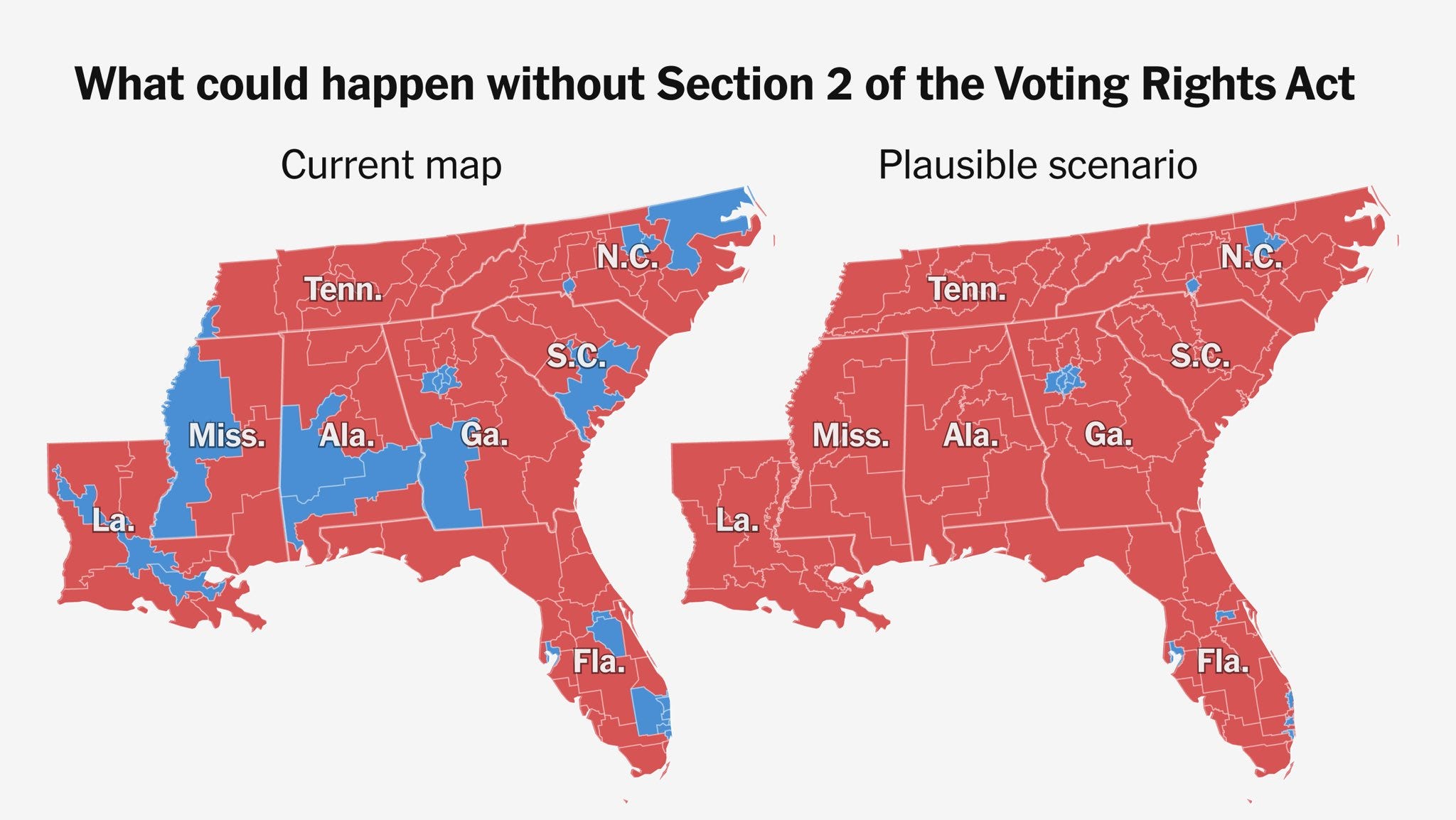
As for the long-term impact of the ruling, it is going to have major implications of which political party will hold control of the House of Representative for years, even decades to come. To put things into context, of the 435 seats in the House, about 29 seats are racially-gerrymandered; all of which are represented by Democrats in Congress. The vast majority of those seats are all located in the Deep South, where voters are heavily Right-Leaning in views. That means based on current map projections, Republicans stand to pick up approximately 12 House seats following this ruling:
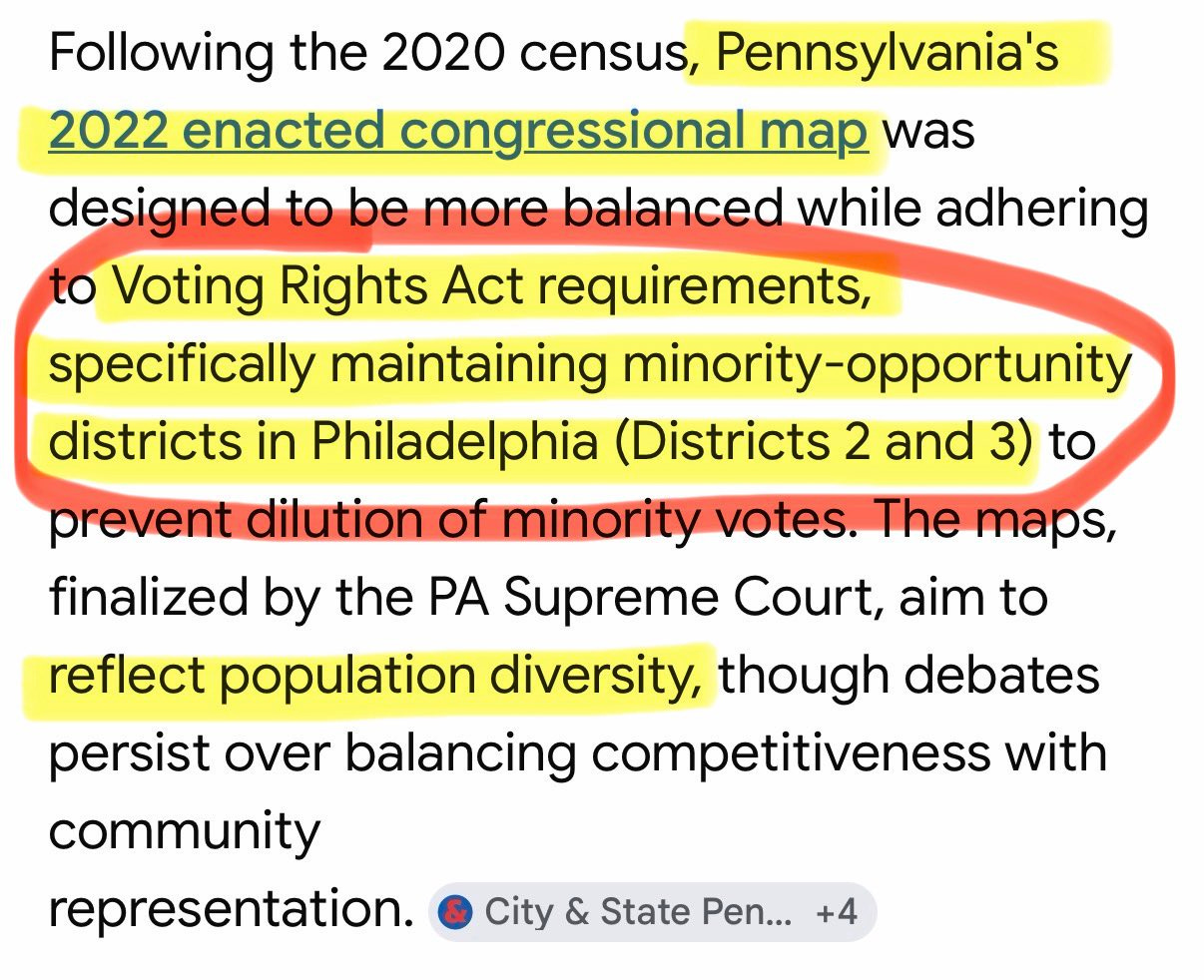
It is not just the southern U.S. states that will be impacted by this ruling. The Commonwealth of Pennsylvania also drew two of their House districts in Philadelphia based on racial-gerrymandering:
The re-drawing of the Maps could also lead to various sitting Democrat Congressmen, like Bennie Thompson, Jim Clyburn, and Bobby Scott—all of whom have been in office for over 30 years—to be forced out of office by these new Congressional Maps. Based on many predictions, following the 2030 elections, Democrats likely will struggle to gain a House majority for decades once the 2032 Presidential Election cycle hits.
In the end, the Supreme Court’s decision in Louisiana v. Callais stands as a victory for free and fair elections because it rejects the use of race as the predominant factor in drawing congressional districts. By reaffirming that Section 2 of the Voting Rights Act does not mandate proportional racial representation or require states to maximize majority-minority districts, the ruling restores primacy to race-neutral redistricting principles—such as compactness, respect for political subdivisions, and legitimate partisan considerations. This prevents the government from engaging in racial sorting that treats citizens as members of demographic blocs rather than equal individuals, reducing the risk that maps will be engineered to predetermine outcomes on the basis of skin color. In doing so, the decision better aligns districting with the core promise of equal protection under the law and helps ensure that electoral outcomes reflect the actual preferences of voters within reasonably drawn boundaries, rather than judicially encouraged racial engineering.
Nice work and i love the details