
Understanding the Tariffs a Little Better
Breaking down exactly the purpose of these Tariffs, the final end goal with them are, and the results so far post-"Liberation Day".

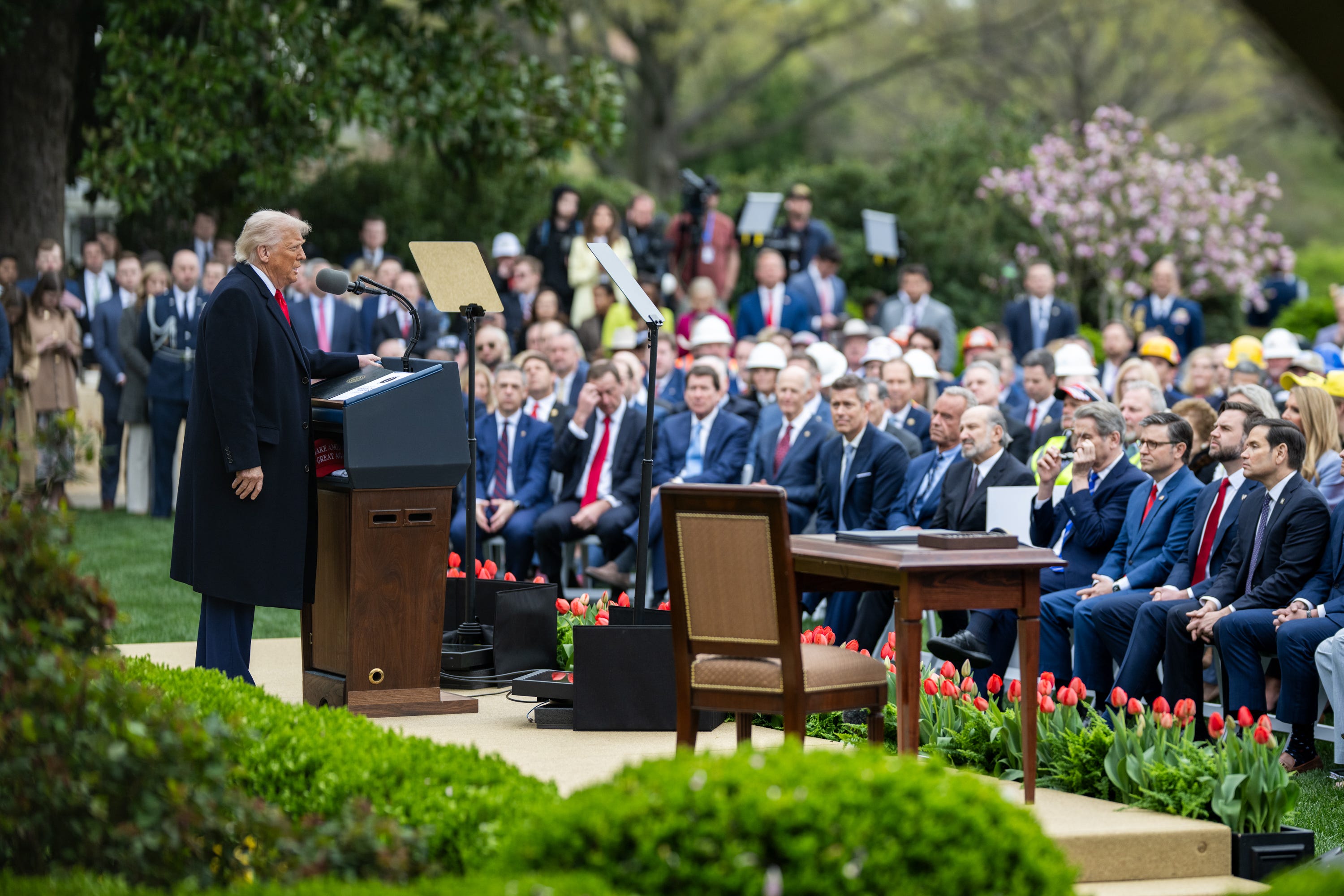
It has now been two months now since President Trump’s “Liberation Day” when he unleashed tariffs on virtually every country around the world. The second Trump signed off on the tariffs, a handful of select “experts” immediately warned Trump will crash the economy. They claimed that the economic state would crash the stock market, and increase inflation. So that begged these questions: Why do all this? Why make such an irrational decision if all of the experts say otherwise? “How will this save the economy?” a core issue of his campaign.
Now I won’t sugarcoat, my expertise is not rooted in economics. Instead, my focus is in political, legal, and policy analysis. When I graduated college a year ago my major was in Political Science, not Economics. So, the purpose of this article is not necessarily to know the economics of tariffs, or why they are “good or bad”, but rather, this article is to make the case for why Trump’s Tariff mandate was necessary, based on the politics surrounding the economic state we are currently in.
Breaking down the Tariff Mandate
The core executive documents that make up the majority of President Trump’s tariffs are as follows:
First, there is his automobile tariff, signed on March 26, 2025. It was Proclamation 10908, titled “Adjusting Imports of Automobiles and Automobile Parts into the United States,” which invoked Section 232 of the Trade Expansion Act of 1962 to impose a 25% tariff on imports of automobiles and certain automobile parts, addressing a critical threat to U.S. national security. The threat at hand here is that excessive imports of automobiles and parts weaken the U.S. automotive industry, reducing domestic manufacturing and R&D capacity vital for economic stability and national defense. This could impair the production of military vehicles and technologies, exposing supply chain vulnerabilities.
Second, on April 2, 2025—Liberation Day as President Trump likes to call it—Executive Order 14257 was signed. It was titled “Regulating Imports With a Reciprocal Tariff To Rectify Trade Practices That Contribute to Large and Persistent Annual United States Goods Trade Deficits.” Using the Executive Powers allowed under the International Emergency Economic Powers Act (IEEPA), President Trump invoked 10% Tariffs on all countries, starting on April 5th. Individualized, higher tariffs on countries with the largest U.S. trade deficits, would begin starting April 9th. The plan is for tariffs to remain until the trade deficit and other non-reciprocal issues are resolved.
An interesting feature about the Liberation Day tariff is the fact that in its Section 4(c) it lays out what Modification Authority is in very simple terms. In Section 4(c)it states:
“Should any trading partner take significant steps to remedy non-reciprocal trade arrangements and align sufficiently with the United States on economic and national security matters, I may further modify the [Harmonized Tariff Schedule of the United States] (HTSUS) to decrease or limit in scope the duties imposed under this order.”
If one “reads the fine print”, this effectively means that a country can easily get rid of Trump's tariffs by removing their own tariffs imposed upon the United States.’
The Predictions vs. Reality Post-‘Liberation Day’
There were many high profile economists that predicted Trump’s tariffs would ultimately lead to a major market crash. One of the predictions that went the most viral with this claim was made by Jim Cramer, who thought that by the following Monday of April 7th the Market would face a “Black Monday” crash similar to what happened in 1987. While it is true that the stock market did indeed go “down”, and it had its worst week post-COVID pandemic, it was nowhere near the crash-level territory we were warned about. Just take a look at this chart of the Dow Jones Market below:
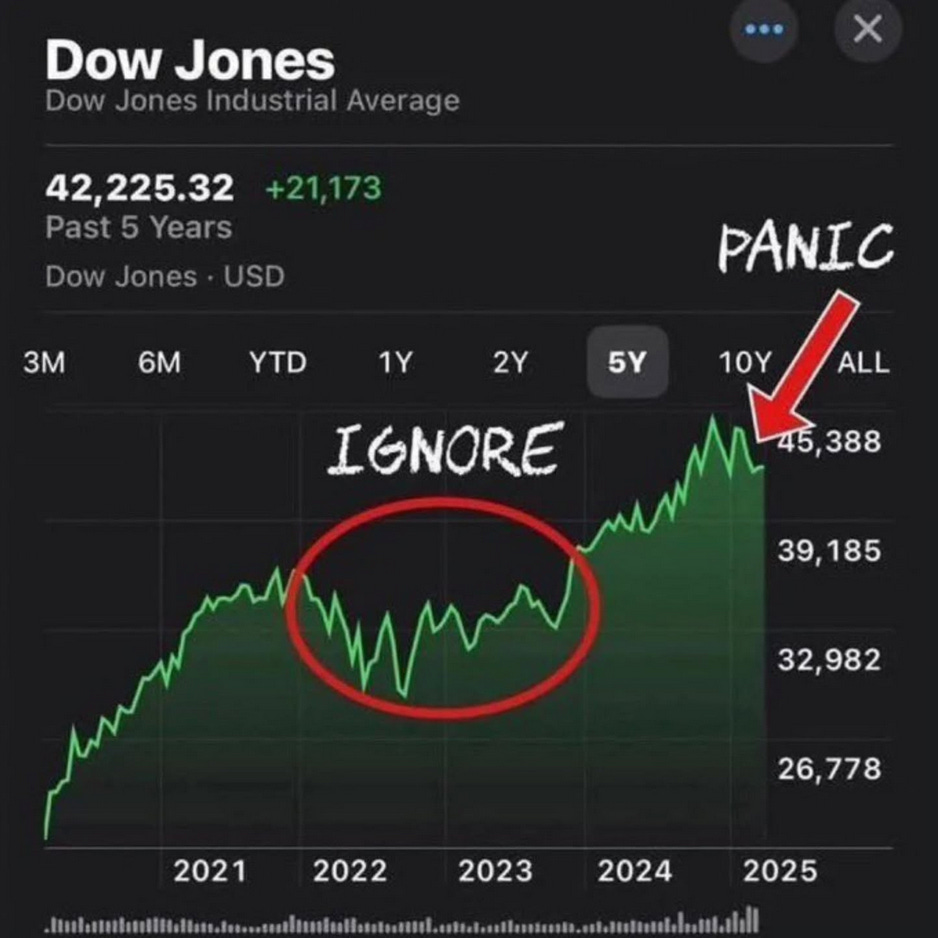
This image represents the track of Dow Jones’ value over the last five years. One can clearly see that right after tariffs were implemented the Dow dropped a couple of thousand points to just under 45,000. Compare that to the last four years under the Biden-Harris Administration practically zig-zagging back-and-forth between 30,000 and 39,000 during the years 2022 to 2024 (considered post-COVID years). This is a rather hilarious observation, given that throughout the previous administration, it was emphasized multiple times that the stock market does not reflect the economy, nor should we bother giving the President sole credit for how the Stock Market reacts. Granted, at this point in the observations, we were still in the first week of April. So, what has happened in the last two months since the tariffs have been imposed?
Well for one, the market didn’t crash, this was mostly due to Trump’s follow-up Executive Order signed on April 9th, enacting a 90-day pause on the Tariffs to allow all nations to initiate formal negotiations. Trump has been calling out for decades how America has been getting “ripped off” by virtually every developed country in the world, and how our trade deals always saw us on the “short end of the stick”. Since many countries have a tariff on the United States, Trump figured that reciprocal tariffs could be the best strategy to enable a reset on trade deals; thereby, leveling the playing field. Immediately upon the announcement of Trump’s reciprocal tariffs, nations such as Israel, Vietnam, and Taiwan began talks to end all tariffed imports from the United States. Zimbabwe officially became the first country to end their American tariffs, followed by talks with Italy, and an officially scheduled meeting with Vietnam. Then, in early May, India offered the Trump Administration zero-for-zero tariffs on auto parts, steel, and pharmaceuticals.
The core issue the tariffs were intended to address was to enable America to increase domestic manufacturing and become a leading world exporter of goods. This concept, known as “reshoring”, aims to rebuild domestic industries like manufacturing, create jobs, and strengthening the U.S. industrial base. Since the start of President Trump’s second term, dozens of foreign and domestic companies have become part of an extensive list choosing to invest and innovate in the United States. Among those companies are: $23B from Novartis, $500B from Nvidia, $150B from IBM, $336M from Lego, $3B from Heinz, $4B from GlobalWafers, $20B from John Deere, $400M from Stellantis, $135M from JBS USA. In response to automobile tariffs, companies such as Volkswagen, Honda, Toyota, and General Motors, are investing hundreds of millions of dollars into the U.S. Honda in particular will invest in American-made car batteries, over options in Japan or China, as well as shifting its 5-door Civic Hybrid manufacturing from Japan to Indiana. Many critics argued that it would make purchasing American-made cars like Honda extremely expensive, but 70% of Honda’s cars are made in America, so there would be minimal impact from tariffs.
In terms of international relations on trade, President Trump has secured major victories in his attempt to prioritize fair trade that benefits the United States. Among major deals are the trade deal with the United Kingdom, which resulted in the UK’s tariffs declining by 64% (5.1% to now 1.8%), while U.S. tariffs increase from 3.4% to, ultimately, 10%. Furthermore, the deal allows UK-made products like Rolls Royce engines and other plane parts to come into the U.S. TARIFF-FREE—and that the UK will buy $10 BILLION worth of Boeing planes. Then, following his trip to the Middle East, President Trump scored over $2.5 Trillion in historic trade and investment agreements with the nations of Saudi Arabia, Qatar, and the United Arab Emirates. Trump also recently threatened the European Union with 50% tariffs, but decided to postpone those through July so hopefully a deal could be put into place. The biggest challenge Trump faces now is with China. Trump and Xi have been going back-and-forth with increasing tariff threats on each other’s country. While this back-and-forth has been going on, there has been some positive results for the U.S., including China officially ending their 125% ethane tariff that was used as leverage due to how China accounted for nearly half of U.S. ethane shipments (492,000 barrels per day in 2024), and the US government securing a trade agreement in Geneva to pause all retaliation tariffs between China and the U.S. to work out negotiations. Unfortunately, the deal was already abrupted within a matter of weeks because China already broke the agreement according to President Trump.
At this point, I have described various facts on deals and investments that will impact the economy, but you are probably wondering, “What about the actual economy itself?” Completely valid, and the most important question that still needs to be answered for us to know if tariffs are harming the economy or not. Despite all of the forecasts warning about market crashes or looming recessions, the economy is actually in a very stable position right now. For example, when it came to job opportunities, the U.S. added 177,000 jobs post-tariffs in the month of April vs 138,000 expected. The Bureau of Labor Statistics job report for May is still to be released. With regard to inflation, in the month of April the Inflation expectations MISSED; producer prices actually fell to -0.5, when they were expected to RISE +0.2%. Then, over Memorial Day Weekend, gas prices hit their lowest level in 22 YEARS, and also the lowest in 4 YEARS when not accounting for inflation. By the end of May, core inflation fell to its lowest rate in four years. Also, consumer confidence surged in May, with its biggest monthly jump in four years, according to the Consumer Confidence Index — this far surpassed many economists’ expectations. As a matter of fact, there is clear evidence showing that economic decline fears from Democrats and Experts were completely overblown.
The Looming Legal Battles
Unfortunately, President Trump has been in legal limbo with the Federal Courts regarding the constitutionality of his Executive Powers, as related to utilizing tariffs. On May 28, the U.S. Court of International Trade ruled that Trump’s Liberation Day Tariffs were deemed illegal. President Trump immediately filed an appeal, and the Federal Court of Appeals temporarily reinstated the tariffs the following day, while further adjudication unfolds. At the timing of this article, adjudication is still in progress, and we do not know what the official court ruling will be. My best guess is that the higher Courts will rule in President Trump’s favor for no other reason than that the Letter of the Law is on the President’s side on this issue. The Trade Act of 1974 could not be more clear. It allows the President to impose tariffs if a foreign country does not “play fair”.
19 U.S.C. § 2411(a)(1):
"If the United States Trade Representative determines that—
(A) an act, policy, or practice of a foreign country is unreasonable or discriminatory and burdens or restricts United States commerce, and
(B) action by the United States is appropriate, the Trade Representative shall take all appropriate and feasible action authorized under subsection (c) to obtain the elimination of that act, policy, or practice."
19 U.S.C. § 2411(c)(1):
"For purposes of carrying out the provisions of subsection (a) or (b), the Trade Representative is authorized to—
(A) suspend, withdraw, or prevent the application of, benefits of trade agreement concessions to carry out a trade agreement with the foreign country subjected to the action under this section, and
(B) impose duties or other import restrictions on the goods of, and, notwithstanding any other provision of law, fees or restrictions on the services of, such foreign country for such time as the Trade Representative determines appropriate."
The Trade Expansion Act of 1962 empowers the President to impose tariffs if he deems it necessary to maintain national security.
U.S.C. § 1862(c)(1)(A):
"Within 90 days after receiving a report submitted in which the Secretary of Commerce finds that an article is being imported into the United States in such quantities or under such circumstances as to threaten to impair the national security, the President shall— determine whether the President concurs with the finding of the Secretary, and if the President concurs, determine the nature and duration of the action that, in the judgment of the President, must be taken to adjust the imports of the article and its derivatives so that such imports will not threaten to impair the national security."
19 U.S.C. § 1862(c)(3)(A):
"If the action taken by the President is the negotiation of an agreement, and if such agreement is not entered into within 180 days after the date on which such action is taken, or if such agreement is not being carried out or is ineffective in eliminating the threat to the national security posed by imports of such article, the President shall take such other actions as the President deems necessary to adjust the imports of such article so as not to threaten to impair the national security. Such actions may include the imposition of tariffs, quotas, or other measures."
But, the “big one” is the International Emergency Economic Powers Act (IEEPA), which gives the President more tariff authority for purposes of economic security.
50 U.S.C. § 1701(a):
"Any authority granted to the President by section 1702 of this title may be exercised to deal with any unusual and extraordinary threat, which has its source in whole or substantial part outside the United States, to the national security, foreign policy, or economy of the United States, if the President declares a national emergency with respect to such threat."
50 U.S.C. § 1702(a)(1):
"At the times and to the extent specified in section 1701 of this title, the President may, under such regulations as he may prescribe, by means of instructions, licenses, or otherwise—
(A) investigate, regulate, or prohibit— (i) any transactions in foreign exchange, (ii) transfers of credit or payments between, by, through, or to any banking institution, to the extent that such transfers or payments involve any interest of any foreign country or a national thereof, (iii) the importing or exporting of currency or securities, by any person, or with respect to any property, subject to the jurisdiction of the United States;
(B) investigate, block during the pendency of an investigation, regulate, direct and compel, nullify, void, prevent or prohibit, any acquisition, holding, withholding, use, transfer, withdrawal, transportation, importation or exportation of, or dealing in, or exercising any right, power, or privilege with respect to, or transactions involving, any property in which any foreign country or a national thereof has any interest by any person, or with respect to any property, subject to the jurisdiction of the United States."
If that’s not sufficient, here's another one for consideration: Trading with the Enemy Act of 1917 50 U.S.C. § 4305(b)(1):
"During the time of war, the President may, through any agency that he may designate, and under such orders, rules, and regulations as he may prescribe—
(A) investigate, regulate, or prohibit, any transactions in foreign exchange, transfers of credit or payments between, by, through, or to any banking institution, and the importing, exporting, hoarding, melting, or earmarking of gold or silver coin or bullion, currency, or securities, and
(B) investigate, regulate, direct and compel, nullify, void, prevent or prohibit, any acquisition, holding, withholding, use, transfer, withdrawal, transportation, importation or exportation of, or dealing in, or exercising any right, power, or privilege with respect to, or transactions involving, any property in which any foreign country or a national thereof has any interest, by any person, or with respect to any property, subject to the jurisdiction of the United States."
Oh, and ANOTHER one: Tariff Act of 1930 19 U.S.C. § 1351(a)(1):
"For the purpose of expanding foreign markets for the products of the United States (as a means of assisting in establishing and maintaining a better relationship among various branches of American agriculture, industry, mining, and commerce) by regulating the admission of foreign goods into the United States in accordance with the characteristics and needs of various branches of American production so that foreign markets will be made available to those branches of American production which require and are capable of developing such outlets by affording corresponding market opportunities for foreign products in the United States, the President, whenever he finds as a fact that any existing duties or other import restrictions of the United States or any foreign country are unduly burdening and restricting the foreign trade of the United States and that the purpose above declared will be promoted—
(A) may enter into trade agreements with foreign governments or instrumentalities thereof; and
(B) may proclaim such modification of existing duties and other import restrictions, or such additional import restrictions, or such continuance, and for such minimum periods, of existing customs or excise treatment of any article covered by foreign trade agreements, as are required or appropriate to carry out any foreign trade agreement that the President has entered into hereunder."
The Ultimate End Goal—If We’re Lucky
The Trump administration’s tariff strategy is a high-stakes gamble, but it’s not a reckless one. At its core, the plan is laser-focused on tackling the United States’ ballooning deficit and debt crisis, a fiscal ticking time bomb that threatens long-term economic stability. With $9.2 trillion in maturing debt to refinance in 2025—$6.5 trillion of it due by June—the administration is betting that tariffs can generate the revenue and economic leverage needed to navigate this “debt wall.” The numbers are staggering, but the strategy is clear: by generating an estimated $700 billion in tariff revenue in the first year. $15.9 Billion in tariff revenue was collected in April, and then the U.S. collected a record-breaking $22.3 billion in tariff revenue in May. The government aims to create fiscal breathing room, potentially funding tax cuts and preserving critical programs like Social Security and Medicaid, without adding to the deficit. Pair this with aggressive spending cuts—potentially $1 trillion by late 2025, driven by the Department of Government Efficiency and figures like Elon Musk—the administration is attempting to stabilize the nation’s finances while fostering growth by reshoring industries.
But, the end goal is bigger than just balancing the books. By making imports more expensive, tariffs aim to rebuild American manufacturing, creating jobs and reducing reliance on foreign goods. The early signs are promising. As mentioned, companies like Honda, Toyota, and Nvidia are investing billions in U.S. production, and trade deals with nations like the UK and Gulf countries signal a shift toward fairer trade terms. Geopolitically, tariffs are a cudgel to renegotiate global alliances, pressuring countries like China, European Union members, and Canada to align with U.S. interests. Domestically, the focus on battleground states like those with steel and auto industries is a calculated move to secure political wins by 2026. If successful, this could mark a historic reset of America’s economic and global standing, turning a debt crisis into an opportunity for industrial and diplomatic renewal.
Yet, let’s not kid ourselves—this is a roll of the dice. The strategy hinges on delicate assumptions: that inflation won’t spiral out of control, that reshoring will deliver jobs fast enough to offset higher prices, and that global trade partners will bend rather than break under tariff pressure. The legal battles over Trump’s executive powers, like the ongoing challenge in the U.S. Court of International Trade, add another layer of uncertainty. If inflation spikes, if industries fail to return, or if trade wars escalate—especially with heavyweights like China—the economic fallout could be severe, politically toxic, and potentially catastrophic. The economy’s surprising resilience thus far—177,000 jobs added in April, falling producer prices, and record-low gas prices—offers hope, but it’s still in the early days. The tariffs are a bold bet on America’s ability to reshape its future, but like any gamble, the outcome is far from guaranteed. If we are lucky, this could be a masterstroke that tames the deficit and revitalizes the Nation. If not, the price of ambition might be steeper than anyone bargained for.
Thank you for taking the time to read! If you enjoyed it and wish to support my future work, you can tip me at this link: https://buymeacoffee.com/timelinesandheadlines
Thank you so much!