
Why Kamala Lost
A retrospective analysis of the one of most consequential failing Presidential Campaigns forged from making mistake after mistake.

It's been over one year since former Vice President Kamala Harris launched her failed campaign for the 2024 Presidential Election. It is universally agreed upon that her campaign was an unprecedented one, whether you supported her or not. Her campaign only launched as a result of President Biden suspending his campaign before the election, the first incumbent President to do so since Lyndon B. Johnson in 1968. Furthermore, Kamala Harris was also the first to be nominated without winning the primaries since the modern Democratic Party primary procedure was created in 1972. In a campaign that lasted only 107 days, and despite having spent nearly $1.2 Billion on hand, as well as being the sitting VP for the incumbent party, one would have thought she stood a fair chance. In the end, she suffered a major defeat against Donald Trump, losing every battleground state, the Electoral College (226-312), and the first Popular Vote (75 Mil < 77.3 Mil) defeat for a Democrat since 2004.
So even with the home-field advantage, how did she manage to lose the election?
Earlier this year I wrote a piece explaining what I believed were core contributors that guaranteed Donald Trump’s inevitable re-election victory. Now over a year later since the launch of Kamala’s campaign, I figured it was about time I wrote what actions her side did that led her to inevitable defeat.
Allow me to explain what happened.
The Lack of Authenticity
There is a consensus in the psychology community that people can develop a first impression about a person within a fraction of a second. Of course, there are exceptions to the rule, especially when it comes to opinion viewpoints aimed at public figures. Commonly, when there is a “fresh face on the scene,” no matter the industry, there often is a thrill of excitement for their presence. This phenomenon is known as the “honeymoon phase,” given the psychological reaction is similar to those at the start of a new marriage. Kamala Harris had a very successful honeymoon phase: She was younger than both Biden and Trump, she offered female representation, and she tried to attach herself to current viral trends from last year such as embracing “Brat Summer,” inspired by English pop singer Charlie XCX. That being said, many political analysts, including those on her campaign, acknowledged the honeymoon would come to an end. And oh boy, did it end quickly.
Throughout the first month of her campaign, she did not do a single interview with the press. It was not until August 29, 2024, when she finally did her first sit down interview with Dana Bash on CNN. However, it left the audience with mixed-feelings regarding her response and her choice to do it with her running mate Tim Walz. Many shared the same sentiment in her second interview with 6ABC Philadelphia, commenting how she essentially regurgitated the same quotes she pulled from a debate with Trump a few days prior. For many voters, they felt dissatisfied with these interviews, given their short runtime as well as there being a sense of scriptedness to them.
On the other hand, Donald Trump made waves with his unprecedented campaign maneuvers by focusing almost entirely on sit down interviews with a major twist: Embracing the podcasters. Podcasts have quickly become one of the most popular mediums people use to gain knowledge on virtually any subject. A key element of Trump’s 2024 campaign was focused on his “podcast tour,” where he would do sit-down, uninterrupted interviews on podcasts that are extremely popular among Generation Z voters. This was crucial since many Gen Z voters are either politically independent or apolitical. Those podcast interviews (with view counts based at the time of Election Day) included:
Tim Pool / Timcast IRL: 1.1 Million Views
Impaulsive: 6.8 Million Views
Adin Ross: 2.8 Million Views
This Past Weekend w/ Theo Von: 15 Million Views
The Shawn Ryan Show: 3.8 Million Views
The Lex Fridman Podcast: 7.4 Million Views
The Dave Ramsey Show: 4.5 Million Views
The Flagrant Podcast: 9.1 Million Views
Full Send Podcast: 3.3 Million Views
Bussin’ with the Boys: 470 Thousand Views
The PBD Podcast: 3.1 Million Views
The Joe Rogan Experience: 54 Million Views
Kamala Harris, trying to mimic Trump’s playbook, attempted to go on podcasts herself, aiming to win over female Generation Z voters. Ultimately, she only went on one podcast, titled Call Her Daddy, which is hosted by influencer Alex Cooper. The interview was considered a disaster on all fronts for varying reasons. Many voters felt Alex did not press Kamala on hard enough questions, and the interview was only available on Spotify and Apple Podcasts, but not on YouTube for her general audience. The only exception was an eight minute clip of the interview with Alex and Kamala discussing abortion and reproduction. This particular clip is fascinating for several reasons. First, this clip barely went viral despite Call Her Daddy’s popularity, and it only just broke one million views very recently despite it being released 10 months ago (as of the date that I am publishing this article). It is also interesting because it can be presumed this abortion-focused segment was most likely selected by the Harris Campaign because they viewed it as a top election issue. However, polling data from both Pew Research and Gallup determined empirically that the majority of voters did not care about abortion as a top priority for their vote choice. Furthermore, the Call Her Daddy interview did not even take place in Alex Cooper’s own studio—the campaign built a replica—costing over $100,000.
Kamala’s team did attempt to match Trump by going on Joe Rogan’s podcast, but ultimately that never happened. It was later revealed from inside sources that Kamala would have had to travel to Austin for the interview, and partake in unscripted topics of Rogan’s choice, neither of which she was interested in.
Selecting Tim Walz as her Running Mate
When it comes to election year politics, the candidate’s selection of their running mate for Vice President is among the most critical decisions for successfully winning an election. The politics surrounding consideration of the top contenders for a potential running mate often key to establishing a winning Presidential ticket. To guarantee the presidential candidate picks the best running mate possible, the campaign team establishes a pool of top contenders who undergo an extreme vetting process, often taking weeks (if not months) to complete. Consideration is given to elements such as the individual's personal life, their influence in politics, where they are regionally influential in the country, etc. Selecting a running mate based on their region in the country has a long history of contributing to Presidential electoral victories. President Kennedy selected Lyndon Johnson in 1960 specifically because it would help win Texas. Barack Obama selected Joe Biden in 2008 to help secure the vote in Pennsylvania. Donald Trump picked Mike Pence in 2016 then JD Vance in 2024 to help secure Midwest voters in the Rustbelt States.
Kamala Harris, on the other hand, had a rather unconventional approach. Given how abrupt the launch of her campaign was, her team essentially had to rush their selection process. There was a lot of speculation as to who she was going to pick. Among the list of top choices included two very popular Democrat politicians. The first option was thought to be Mark Kelly, a U.S. Senator from Arizona and a former astronaut, who many felt would appeal to moderate voters and secure the Sun Belt states. The second option was thought to be Governor of Pennsylvania Josh Shapiro, who would have been even more critical given that the consensus was whoever won Pennsylvania would win the White House. In the end, however, her team wound up choosing neither of them. Enter Minnesota Governor Tim Walz.
Despite progressive activists claiming Walz was the right choice given his fatherly presence, it became evident quickly that there was a lot of baggage he brought with, but which had flown completely under their radar:
Walz handled the deployment of the National Guard troops in Minneapolis during the George Floyd / Black Lives Matter riots very poorly.
Tim’s daughter, Hope Walz, leaked the Guard's deployment plans online, so that rioters would know how long they had to loot the city with impunity.
Under his leadership as Governor, Minnesota has seen some of the most radical Transgender medical surgery laws for minors in the country.
Minnesota has the most radical abortion laws in the country.
Tim Walz oversaw the single worst fraud of the Covid era, the Feeding Our Future case. Thanks to ineptitude at the Department of Education, criminals stole $250 million of taxpayer dollars to spend on luxury cars, houses, and vacations. The masterminds were found guilty in March 2025.
Also during the Covid Era, he approved $500 million in "hero pay" for frontline workers, only to have 40% of that money go to people who were ineligible, or in many cases, actually deceased.
And, during COVID, Walz made Minnesota one of the most restrictive places to live in the country. He even implemented a hotline for people to snitch on neighbors who were breaking lockdown orders. It remained active until 2022.
So, the question remains: How did the Harris Campaign know nothing about his baggage? The best argument I could come up with is that, at least before the election, most people nationwide barely knew who Tim Walz was. That in itself was a problem in his home state of Minnesota. I only bring up its relevance because, as I stated earlier, most running mates are selected to potentially help picking up a key battleground state. Minnesota has been a safe Democrat Blue state for decades—since 1976—almost 50 years ago. Ultimately, Kamala’s team failed to do the most basic vetting on Tim Walz. They didn’t even vet if he would be good at debating against JD Vance. Most analysts agree that Vance won the VP Debate, and it wasn’t close.
Running to Save Democracy…Except when it was Getting in Her Way
A core part of Kamala Harris’ presidential campaign revolved around how she wanted to help “preserve democracy.” A lot of Americans felt that the 2024 election would determine the fate of democracy. I have always felt that this position from the Democratic establishment is laughably ridiculous for a few reasons. First of all, the United States is not now, nor has it ever been, a Democracy, rather it is a Constitutional Republic, which is a world of difference. As for the specifics of this difference, I shall save that discussion for a future article. Back to the point of “saving democracy” being a talking point used to win over voters for Harris. Let’s say that, hypothetically, this is true, that the United States is a democracy, and that Kamala Harris and the Democratic Party were prioritizing the supposed threats to Democracy. Even if this was the reality of the election, the Democrats would be the biggest hypocrites in politics because apparently they never truly cared about democracy, seemingly not letting the practice of Democracy gett in the way.
What I am referring to is how the Democratic Party went against the values of democracy—majority rule through 1 person = 1 vote—by actively disenfranchising the American voter base by not allowing them to vote for the candidates of their choice. By their actions, Kamala Harris became the Democratic nominee without earning a single vote from the primaries, meaning that American voters had no say in who their party ran on the Democratic ticket.
Throughout the 2024 election cycle, several lawsuits arose due to Democrat-run states blocking a candidate’s ballot eligibility. It happened with Green Party candidate Jill Stein in Georgia and Wisconsin, Socialist candidate Dr. Cornel West in Michigan and Pennsylvania, Independent candidate Robert F. Kennedy Jr in North Carolina and Pennsylvania, and of course Donald Trump was briefly removed in Colorado. All of these examples were specifically aimed at blocking candidates from running in key battleground states so they would not spoil the electoral turnout for Joe Biden and then eventually Kamala Harris.
While it may not have been “illegal” activity conducted by the Democrats, it was extremely hypocritical given their moral grandstanding on the “preservation of democracy”. You cannot “save democracy” if it requires you to cancel out someone else’s choice of democracy because it is inconvenient for you. It is also doing a major disservice to non-Democratic voters (e.g., independent party voters) who feel like they won’t have a voice in the election given that the Harris Campaign did not make efforts to win over third party / independent voters. Therefore, because the Democrats chose to attempt to block ballot access for certain candidates, that resulted in voting blocs doubling down in voting for candidates other than Kamala.
By comparison, Trump and the Republicans used the opposite playbook. Not only did Republican-led forces NOT block candidates on the ballots against their wishes, the Trump Campaign made an active effort to attempt to win over third party and independent voters. As I explained in another article in which I discussed how Trump won, he made a few small but extremely significant moves that consequentially tilted the election in his favor, securing his victory. These actions included choosing to speak at the Libertarian Party convention in May 2024, where he made various pledges, such as freeing Ross Ulbricht.
Later that summer, Trump took it even further by winning over more independent voters in the best campaign move possible.
Declining the Kennedy Alliance
This is just my opinion, but among all of the bad decisions the Harris campaign could have made, I would rank the decision to not align with Robert F. Kennedy Jr. one above all others. Robert F. Kennedy Jr., the son of RFK Sr. and the nephew of President John F. Kennedy, is arguably the most influential living member of the Kennedy Dynasty. A historically Democrat-aligned RFK Jr announced his run for President as a Democrat in 2023, with plans to primary out Joe Biden. In October of that same year, he announced he would re-launch his campaign as an Independent candidate. Throughout his 2024campaign, Kennedy would become very popular among Independent and Right-leaning voters, particularly because his campaign platform comprised two main pillars: eradicating corruption in the Federal government and cracking down on corporate industries slowly polluting the food we eat and the water we drink—RFK’s vision has been to “Make America Healthy Again” (MAHA).
Despite polling well among Independents, it was still not enough for him to win the election. So, behind the scenes, the Kennedy Campaign began reaching out to the Trump and Harris camps for alternative prospects. One day after the attempted assassination of Donald Trump, a leaked video revealed that RFK Jr. called Trump, and they talked about the aftermath of the assassination attempt as well as a few policy issues. Sources also claimed that RFK Jr. attempted to reach out to the Harris campaign for a meeting, but it never happened. Then came the day last year, August 23, 2024—one day after Kamala formally accepted the Democratic nomination—when RFK Jr. suspended his campaign (while still remaining on the ballot in most blue states) and formally endorsed Donald Trump. Kennedy contributed to the Trump campaign by sounding the alarm of the health crisis in America, encouraging all Americans to help make America healthy again by voting for Trump. In the end, Donald Trump would go on to win the election and would nominate RFK Jr. for Secretary of Health & Human Services (HHS). Kennedy would eventually be sworn-in as HHS Secretary on February 13, 2025.
This remains the biggest head-scratcher for me of the entire election cycle. Say you are the candidate of one of the major political parties (the Democratic Party in particular). You are polling relatively (i.e., slightly) better than your main rival opponent. Then, you have an opportunity to secure an electoral landslide by allying yourself with a popular 3rd party candidate—essentially from your same base—that not just polls well, but also could have taken votes away from your main rival. Despite all of those variables, the Harris Campaign still refused to team up with Kennedy. WTF??? Oh, to have been a fly on the wall the day the Harris Campaign made the decision to formally reject Kennedy’s proposal. Of all the behind the scenes events from the 2024 election cycle, this is the one I wish I could have been in the room to hear the justification for, because to this day, I will never understand how Harris thought it would benefit her electoral chances to not team up with RFK Jr.
The Keys Were Genuinely Not in Her Favor
Meet Dr. Allan Lichtman. He is a historian, political analyst, and professor at American University since 1973. He is most famous for creating his “13 Keys to the White House.” The Keys to the White House is a system that uses 13 true/false criteria to predict whether the presidential candidate of the incumbent party will win or lose the next election. The determination of whether the keys are True or False are based on whichever the incumbent party controls the Executive Branch. If the incumbent has at least 6 ”True” keys, Lichman posits that candidate will win the election, but if the incumbent has more than six ”False” keys, then that predicts the incumbent will lose. Dr. Lichtman has been continuously using his 13 Keys to predict who will win the Presidency since he developed the keys in 1973. He has garnered viral media attention for having a near flawless prediction record based on his keys for every election since 1984 (with the exception of the 2000 election). Dr. Lichtman was one of the few public figures to correctly predict Donald Trump would win in 2016, as well as correctly predicting Biden would win in 2020. Interestingly, Dr. Lichtman would go on to predict a Kamala Harris victory in 2024. However, as we all know, he could not have been more wrong in his 2024 prediction.
It should be noted that Dr. Lichtman is a Democrat, and based on his positions illustrated in his published books, has a major anti-Trump bias. After the election, Lichtman did admit he was wrong, but not because of his own biases. Surprisingly, he blamed the voters and “mass disinformation” for why he was incorrect. Granted, Dr. Lichtman is entitled to his opinion and can believe whatever he likes, but what I did not appreciate was his refusal to admit his own biases, which I believe is what cost him his prediction streak.
When one reviews all 13 Keys through an objective lens, it is clearly evident that the keys were actually in Trump’s, not Kamala’s favor. Given that the True/False keys were based on the incumbency of the Biden-Harris Administration—i.e., the Democrats—here is what was true and what was false:
The “True” Keys:
No primary contest: There was no serious contest for the incumbent party nomination.
Major Policy Change: The incumbent administration effects major changes in national policy. (e.g., the American Rescue Plan, the CHIPS and Science Act, the Inflation Reduction Act)
Strong Long-Term Economy: Real per capita economic growth during the term equaled or exceeded mean growth during the previous two terms.
The “False” Keys:
Party Mandate: After the midterm elections, the incumbent party holds more seats in the U.S. House of Representatives than after the previous midterm elections. The Republicans won the majority in the 2022 midterms.
Incumbent Seeking Re-election: The incumbent party candidate is the sitting president. Joe Biden was the presumptive nominee until his withdrawal on July 21, 2024.
No Third Party: There is no significant third party or independent campaign. Green Party candidate Jill Stein was viewed as a direct threat to Kamala’s chances at victory.
Strong Short-Term Economy: The economy is not in recession during the election campaign. There was a recession. Source: House Budget Committee
No Social Unrest: There is no sustained social unrest during the term (Pro-Palestine Riots).
No scandal: The incumbent administration is untainted by major scandal. The Withdrawal itself (in all likelihood due to Biden’s perceived mental acuity) was arguably the biggest scandal at the time.
No Foreign or Military Failure: The incumbent administration suffers no major failure in foreign or military affairs. (e.g., Abbey-gate/Afghanistan withdrawal, Initiating the current Ukraine War, initiating the October 7th attack in Israel)
Major Foreign or Military Success: The incumbent administration achieves a major success in foreign or military affairs. There were none.
Charismatic incumbent: The incumbent party candidate is charismatic or a national hero. Kamla and Biden had very low approval ratings.
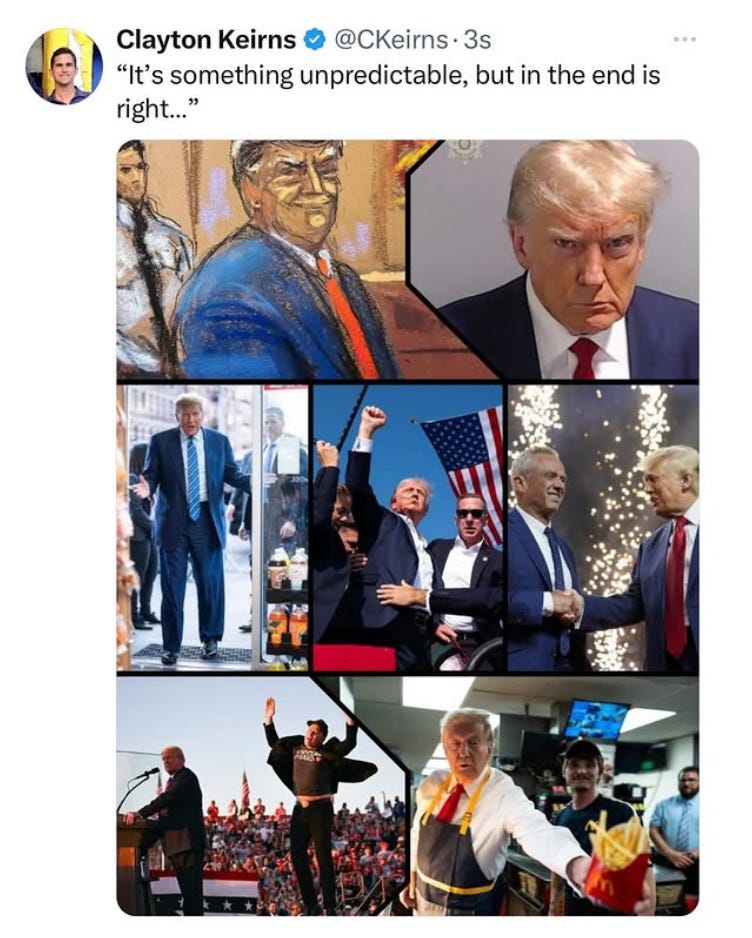
Uncharismatic Challenger: The challenging party candidate is not charismatic or a national hero. They say a picture is worth 1,000 words, so here is one 7,000 words:
A Tale of Learning vs. Stumbling
See Also: Why Trump Won § The Moral of the Story
In the end, the 2024 presidential election boiled down to a stark contrast between two campaigns: one that adapted and one that faltered.
Donald Trump, battle-tested by past campaigns, emerged sharper, wielding a strategy that tapped into the pulse of a changing electorate. He ventured into the uncharted waters of podcast culture, courted skeptical independents, and forged alliances that amplified his reach—most notably with Robert F. Kennedy Jr. His campaign was a calculated dance, sidestepping old pitfalls while capitalizing on his opponent’s stumbles.
Kamala Harris, on the other hand, was thrust into the spotlight under extraordinary circumstances, and seemed to falter at every turn. Her authenticity never took root, leaving voters questioning her substance. The choice of Tim Walz as her running mate, marred by overlooked controversies, proved a liability rather than an asset. Her campaign’s rejection of Kennedy’s public reach was a baffling fumble, alienating a potential bridge to undecided voters. Even her promise to safeguard democracy felt hollow, undermined by tactics that suppressed ballot access for rivals. The political winds, as any clear-eyed observer could see, were never blowing her way. In the end, Trump triumphed because he adapted, learning from the scars of past skirmishes. Harris fell because her campaign was a litany of avoidable errors, each one compounding the last.
Thank you for taking the time to read! If you enjoyed it and wish to support my future work, you can tip me at this link: https://buymeacoffee.com/timelinesandheadlines
Thank you so much!
It was just stupid, Her entire campaign was stupid. it shouldn't have been that hard win an election against a convicted felon.