
The Lawfare Files Part 2: Dismantling the Gaslighting from the Civil Fraud Case
Explaining what why President Trump's civil suit case was a total sham from the beginning.

I understand that as we move along to the rest of President Trump’s trials and lawsuits that there still might be questions regarding my analysis. You may still believe Trump is guilty of at least one of the charges, or most of them, or shoot, maybe all of them. However, I am willing to bet big money that this case—the Civil Case into Trump’s Business “fraud”—will be the one exception to further doubts of his guilt. To say that this trial is arguably the most clear-cut in terms of “bogusness” would be a generous statement at best. In terms of the charges made by the prosecutor, Letitia James, and the ruling by the Judge, Arthur Engoron, this trial is, in my opinion, the most ridiculous attempt yet at gaslighting the American people that there is a “smoking gun” proving President Trump is guilty (beyond a reasonable doubt) of……something.
The General Overview of the Case
The Trump Civil Fraud Case, officially titled the People of the State of New York v. Donald J. Trump et al., is a civil lawsuit filed by New York Attorney General Letitia James against former President Donald J. Trump, his adult sons (Donald Trump Jr. and Eric Trump), former Trump Organization executives Allen Weisselberg and Jeffrey McConney, and several Trump Organization entities. Overseen by New York Supreme Court Justice Arthur F. Engoron, the case centered on allegations of financial fraud under New York Executive Law § 63(12), accusing the defendants of systematically misrepresenting asset values, including those of Trump’s Mar-a-Lago property, to secure favorable loan and insurance terms.
The investigation began in early 2019, triggered by testimony from Michael Cohen, Trump’s former attorney, who accused Trump of inflating his asset values, including those of Mar-a-Lago, to obtain better financial terms. The New York Attorney General’s Office (OAG) issued subpoenas to gather evidence, leading to legal battles overseen by Justice Engoron starting in 2020. On September 21, 2022, the OAG filed the lawsuit, which alleged that Trump and his entities overstated his net worth by up to $3.6 billion annually from 2011 to 2021 through false or misleading Statements of Financial Condition (SFCs). Trump’s property at Mar-a-Lago was a key example, with the OAG claiming its value was inflated by as much as 2,000%, ranging from $405 million to $739 million in SFCs, compared to Palm Beach County tax appraisals of $18 million to $27 million. The OAG argued that Trump valued Mar-a-Lago as a private residence, ignoring deed restrictions that designated it as a social club, rendering such valuations fraudulent.
In September 2023, Engoron granted partial summary judgment, ruling that Trump and his entities committed fraud by inflating asset values, including Mar-a-Lago’s value, by $812 million to $2.2 billion annually from 2014 to 2021. Specifically, Engoron highlighted that Mar-a-Lago’s valuations, such as $420 million in 2020 versus the county’s $26.6 million appraisal, were “arbitrary and unsupported” due to Trump’s use of residential comparables despite deed restrictions. Engoron ordered the cancellation of business licenses for several Trump entities, including the Trump Organization, and appointed a receiver to oversee their dissolution, though this was stayed pending appeal.
The non-jury trial, presided over by Engoron, ran from October 2, 2023, to December 13, 2023, with closing arguments on January 11, 2024. The OAG sought $370 million in disgorgement (up from $250 million) and a lifetime ban on Trump’s participation in New York’s real estate industry. Mar-a-Lago’s valuation was a central issue, with the OAG presenting evidence that Trump’s SFCs misrepresented its value by ignoring its status as a commercial social club and deed restrictions prohibiting residential use. On February 16, 2024, Justice Engoron issued his final ruling, finding Trump and his entities liable for fraud, falsifying business records, issuing false financial statements, and conspiracy.
The court imposed a $364 million penalty, plus interest, totaling over $450 million, against Trump, his sons, and the Trump Organization. The penalty included disgorgement of profits from fraudulent practices, with Mar-a-Lago’s inflated valuations cited as a key example of the deceptive SFCs that misled lenders and insurers. Trump was banned from serving as a director of any New York company for three years, and his sons were barred for two years. The Trump Organization was prohibited from securing loans with the city for three years. Engoron maintained the independent monitor, Barbara Jones, to oversee the Trump Organization’s operations but stopped short of dissolving its business licenses, modifying his earlier order. He rejected the defense’s claim that no victims existed, emphasizing that Executive Law § 63(12) does not require proof of harm, and noted that Mar-a-Lago’s valuations, such as $420 million versus $26.6 million in 2020, exemplified the “materially false and misleading” statements.
One would think that when reading this overview that would say, “Well, sounds like the judge came to a sound ruling based on the facts and nature of the case.” Except what I am about to share is proof that not only is Trump actually vindicated in this trial, but also proves how there are zero victims, all loans were repaid, and the banks even testified in defense of Trump Hotels.
The Pillars for Total Vindication
I believe there are three critical points that clearly prove why Trump will eventually be vindicated once this trial ends while the appeal is currently pending. Number one, the law that Leititia James and Judge Arthur Engorn are arguing Trump violated is, as stated earlier, New York Executive Law § 63(12). There have been instances where prosecutions have occurred, but those were on charges of consumer fraud. As a matter of fact, an in-depth analysis done by the Associated Press reviewing New York fraud law of the last 70 years, summarized exactly the uniqueness of Trump’s trial: “It’s the only big business found that was threatened with a shutdown without a showing of obvious victims and major losses,” (AP 2024). So, in the case of Trump, it is 100% unprecedented because it is the first case of its kind in which a borrower is being sued for fraud when no one is claiming actual harm.”
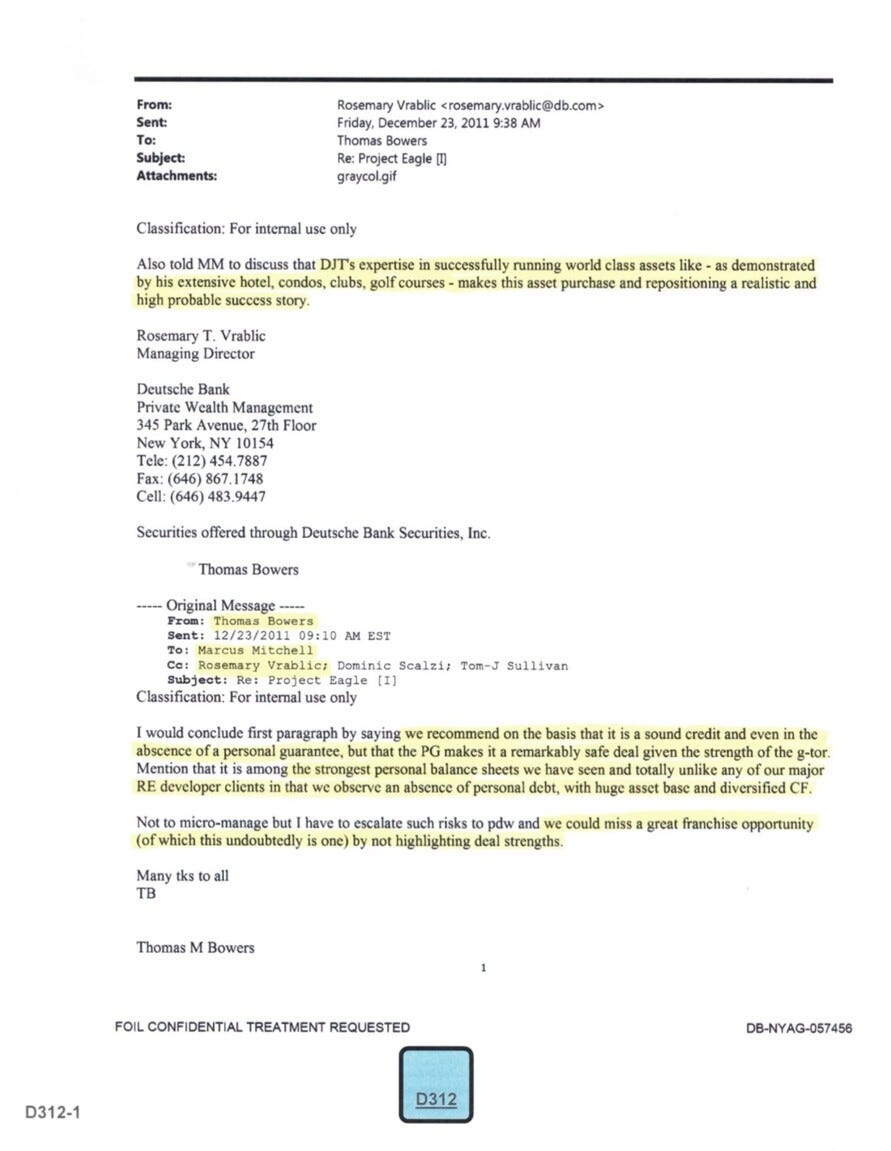
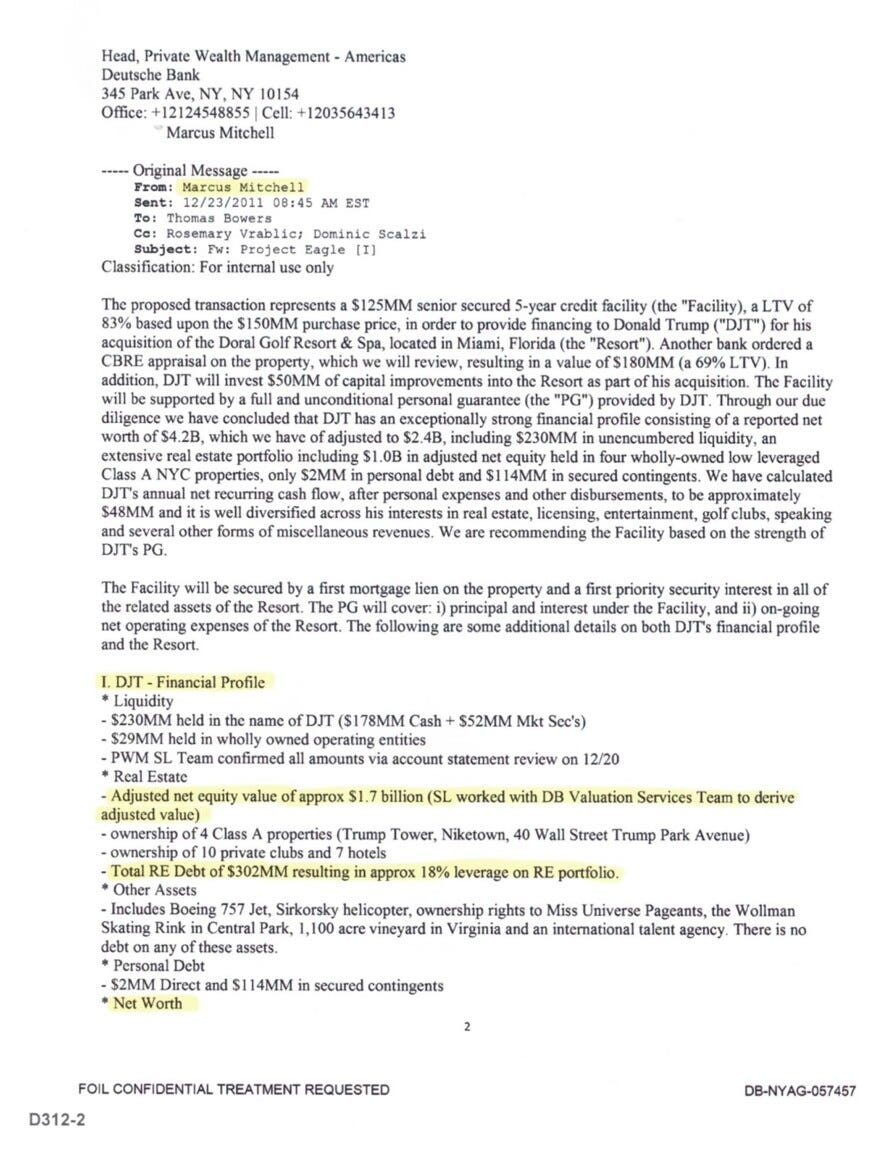
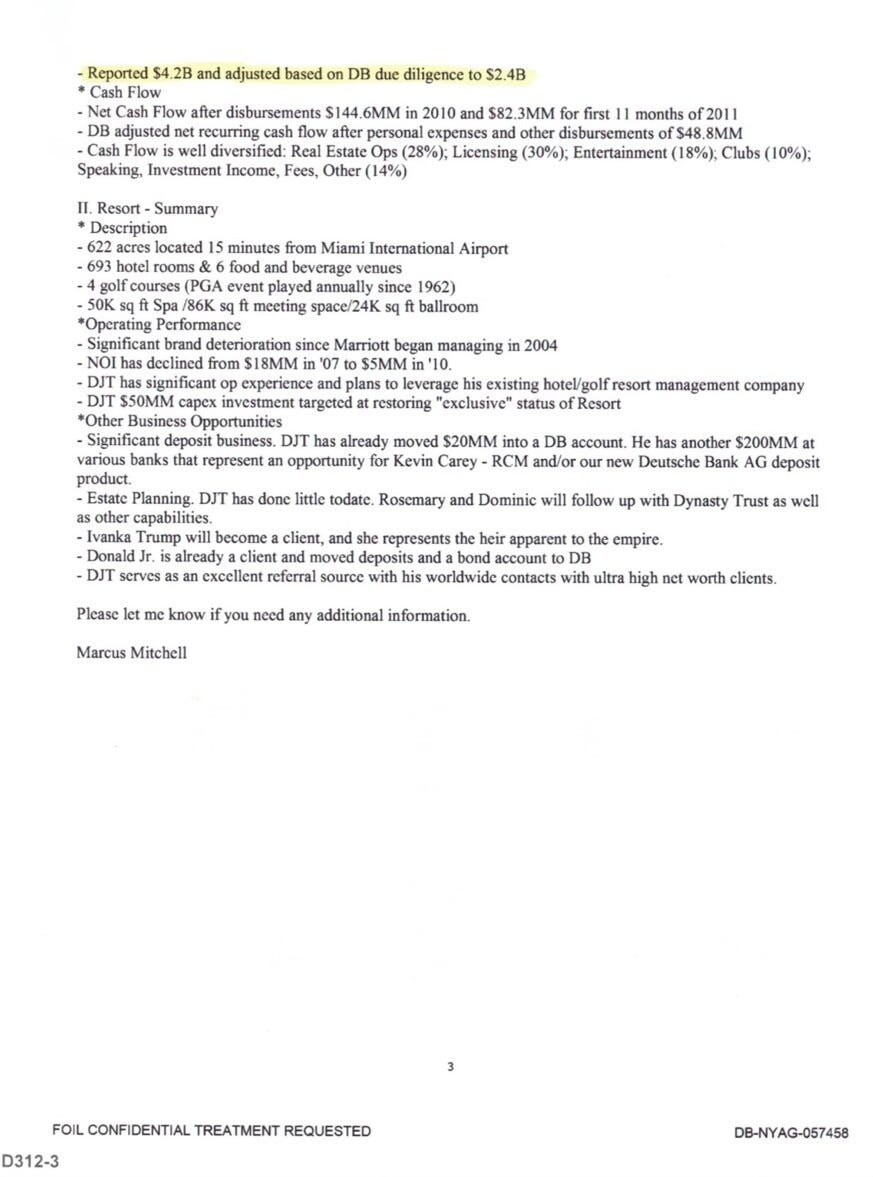
Moving on to point number two, the ultimate proof vindicating Trump of these charges is from the official letter from Deutsche Bank. They wrote that President Trump had one of “the strongest personal balance sheets we have seen and totally unlike any of our major RE developer clients,” and Trump represents “a great franchise opportunity,” and Trump is an expert “in successfully running world class assets.” Here is the letter for you to read with the highlighted key sections:
Lastly, point number three is more about how the ruling made by Judge Engoron contradicts common sense. Granted, I understand that virtually everyone who reads this will not fully comprehend how the world of real estate works, let alone for business activities in New York. But, among businessmen and women that do business in New York? They understand how business and the law works exactly over there, and they understand exactly why the Trump Civil Fraud trial is nothing short of bogus. Canadian businessman and Shark Tank host Kevin “Mr. Wonderful” O’Leary spoke on CNN last year, perfectly summarizing the pure insanity of this whole trial and why it sets a dangerous precedent for those who wish to do business in New York State:
The transcript of his statement is as follows:
“And let’s leave out politics and just talk about what happens in real estate development anywhere. If you’re a developer and you’ve got a building on a block anywhere in America and it’s worth let's say $500 million dollars and you want to build a building right beside it, you go to the bank and say: ‘This building is worth $500 million dollars. I’d like to borrow a Construction Finance Loan against this asset, and I want you to tell me it’s worth $500 million too’. And the bank negotiates with you and says, ‘Well no we think it’s worth $400 million,’ and you fight it out. You’re always trying to show your assets in the brightest light with the sunshine you can possibly determine for them. You want them to be worth the very most, because you’re only gonna get a 40% to 50% ‘loan to value’ as it's called. Then you borrow that money, in the case of a $500 million dollar asset, maybe you get $250 million, and you build a new building with a Construction Finance Loan.
“And so that’s what this case is all about. And by the way, forget about Trump, every single real estate developer everywhere on Earth does this. They always talk about their assets being worth a lot, and the bank says ‘no’, and that’s just the way it is. So, in this case, what I’m trying to figure out—and I’m not pro or con, or I don’t care about the politics—who lost money?? Nobody! The bank got paid back the Construction Finance Loan, and a new building was built, and if you’re gonna sue this case and win, you gotta sue every real estate developer everywhere! This is all they do! This is what they do all day long everyday! So, I don’t think this will ever survive appeal, regardless of what the fine is. This doesn’t make sense.”
Mr. Wonderful might just turn out to be correct in his prediction, President Trump will very likely win in his appeal.
Appealing the Verdict
Immediately following the ruling, President Trump and his sons filed a notice of appeal on February 26, 2024, and would eventually file for a full appeal later last summer on July 22. Eventually, the appeals hearing was finally held on September 26, 2024 in front of a 5-judge panel at the New York Supreme Court. Fun fact: Did you know in New York their “supreme court” serves as the state’s court of appeals, and the “New York Court of Appeals” serves as the state’s supreme court? You learn something new every day. Now, back to the appeal hearing.
The National Desk published the full 50 minute livestream of the oral arguments, which anyone can watch freely at any time. For those who just want a quick summary of the arguments, it is laid out as follows: It was bad for the Democrats, and extremely good for Trump’s defense. I had a feeling that Trump’s legal team would make strong arguments in terms of the facts and unprecedented nature of the case. What I did NOT expect was the Judges going “nuclear” on Letitia James’ team, completely obliterating any and all arguments for proof of Trump’s “guilt”. Probably the best summarization of the entire appeal hearing was covered by political commentator “The Older Millennial” with the following recap.
As of the date of the publication of this article, the appellate panel has still yet to make a formal ruling regarding the appeal. Given that Trump won his re-election and will remain in office until January 20, 2029, it is most likely the ruling will not be made official until after he leaves office.
Closing Thoughts
As outlined, the absence of victims, the repayment of all loans with interest, and the unprecedented application of a consumer fraud statute to a case without demonstrable harm raise serious questions about the motives behind this prosecution. This case’s reliance on Mar-a-Lago’s valuation—ignores the subjective nature of real estate valuation, a practice Kevin O’Leary aptly described as standard in the industry. Engoron’s $364 million penalty, ballooning to over $450 million with interest, and the imposition of business bans, appear disproportionate when banks like Deutsche Bank praised Trump’s financial strength while reporting no losses (i.e., “damages” or “harm”). I would even argue that the penalty is a violation of Trump’s Eighth Amendment rights, which explicitly states, “Excessive bail shall not be required, nor excessive fines imposed, nor cruel and unusual punishments inflicted.”
This case serves as a microcosm of the broader political persecution Trump has faced in recent years. The use of Executive Law § 63(12), a statute rarely applied to such high-profile business transactions without clear victims, suggests a targeted effort to undermine Trump’s financial and political standing. This case would also not be the only time the New York courts weaponize state statutes to attack Trump’s name and character. As explained last week in his criminal trial, then once again today with regard to this civil trial, there is yet another civil case that was a complete slap in the face of everything the Justice system stands for.
Find out in The Lawfare Files part 3 release, next Friday.
Now that all of articles are published, feel free to go back and read the whole series!!
Prologue: Coming Soon: The Lawfare Files
Part One: Breaking Down the Hush Money Trial
Part Two: Dismantling the Gaslighting from the Civil Fraud Case
Part Three: Unraveling the E. Jean Carroll Trial
Part Four: The Racketeering That Never Was: A recap analysis of the failed Georgia RICO prosecution
Part Five: A Stretch of Obstruction: A Breakdown of Jack Smith’s Federal Election Prosecution
Part Six / Finale: The Truth About Trump’s Classified Document Case
Epilogue: The Lawfare Files: Read The Series